

You just bought a new flat in Singapore or decided it’s time to refresh your home. You grab the paint samples, pick your favourite colour, and then a question pops up in your mind: “How Many Coats of Paint Are Required for Interior Walls in Singapore?”
Honestly, most homes do fine with 2 coats of paint, but some walls need extra care, like a primer first or even a third coat, to get that smooth, flawless finish. Knowing this can save you time, money, and frustration.
If you want your walls to look perfect, last long, and handle Singapore’s humid weather, you need to understand why these coats matter and how to choose the right number for each wall. Issues like wall seepage, damp stains, and mould growth are common locally and often linked to poor surface preparation or insufficient coating. You can learn more about these early warning signs in our guide on Common Signs of Water Seepage in Singapore.
Keep reading, and we’ll break it down in simple, easy steps so you can make the best choice for your home.
How Many Coats of Paint Are Required for Interior Walls in Singapore?
When you are getting your walls painted, it’s normal to wonder how many coats of paint are required for interior walls in Singapore. Most homes do well with 2 coats of paint, which gives smooth, even colour and good protection, but sometimes walls need a little extra care.
However, if your walls have been affected by moisture, cracks, or previous water leakage, additional preparation may be required before painting. In such cases, professional Wall Seepage Repair Services is often recommended before applying new paint
For example, if the walls are new, patched, or you are changing from a dark colour to a light one, you might need a primer plus 2 coats or even 3 coats to make the finish perfect.
Using the right number of coats helps your walls look fresh, last longer, and handle Singapore’s humid weather without peeling or staining.
Why Do We Need More Than One Coat of Paint?
Think of paint like layers. Each layer does part of the job.
Coat 1
- This first layer sticks to the wall.
- It starts covering the old colour.
- But it may still look light or patchy.
Coat 2
- This second layer makes the colour even.
- It hides marks.
- It gives a smooth finish.
Extra Coat (Coat 3)
- You may need this when the wall is difficult.
- Like dark colours, damaged walls, or very dry walls.
So:
- 2 coats = standard
- 3 coats = when walls need more coverage.
In Singapore, homes exposed to humidity and water leakage often need extra protection. If your property has a history of leaks, addressing the root cause first is crucial. You may find this helpful: Protect Your Home From Water Damage
Why is This Especially Important in Singapore?
Singapore is hot and humid all year round. Humidity makes walls absorb moisture.
Moisture can cause problems like:
- Paint peeling
- Blistering
- Mould growth
- Stains
- Damp patches
So the right number of coats protects your walls and makes your home last longer.
According to professional paint manufacturers like Benjamin Moore, most interior walls achieve full coverage and durability with two proper coats, while challenging surfaces may require additional layers.
Good painting = beauty + protection.
If moisture problems are not fixed, even the best paint will fail. This is why waterproofing and proper surface preparation play a key role in long-lasting paintwork. Learn how waterproofing improves property durability here: How Waterproofing Can Increase Property Value
When Do You Need 2 Coats vs 3 Coats?
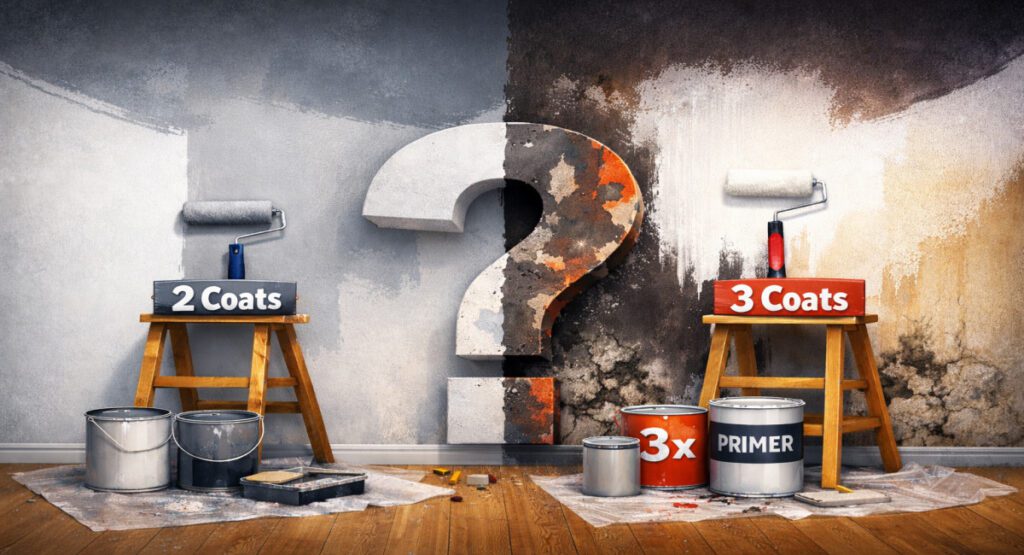
Let’s go area by area.
1. Repainting Walls With the Same or a Similar Colour
If you are just refreshing a wall with the same or a very similar colour, like white to off-white or beige to beige, the wall already has a base that matches the new paint.
This means the colour will cover evenly without much effort. 2 coats are usually enough to give a smooth, clean look that lasts. Applying more than that is not necessary unless the wall has rough patches or marks.
2. Painting Over Dark Colours
Changing a dark wall to a lighter colour, like black to white or navy blue to cream, is trickier. Dark colours can show through the new paint if it’s too thin. In this case, you may need a primer first, followed by 2 coats of paint, or sometimes even 3 coats. This helps hide the old dark shade completely, giving the wall a bright and even finish without any shadow or patchiness.
3. New Walls or Newly Plastered Walls
Brand new walls or walls that have just been plastered absorb paint very quickly, almost like a sponge. If you apply paint directly, it may soak in unevenly and look patchy.
The best way is to use 1 coat of primer first, which seals the wall and creates a smooth base. Then apply 2 coats of paint on top. This ensures the paint sticks well and lasts longer without fading or peeling.
4. Walls With Stains, Mould, or Water Damage
Walls that have mould, water stains, or damp patches need special care. Normal paint alone cannot stop the stains from coming back or prevent mould from growing.
For these walls, use a waterproof sealer or primer, followed by anti-mould paint, and then finish with 2 coats of top-quality paint. This protects the wall, prevents stains, and keeps it looking fresh for years, even in Singapore’s humid climate.
5. High Use Areas
Some areas in your home get more wear and tear than others, like the living room, hallways, and kids’ rooms. These walls get touched, bumped, and cleaned more often, which can make paint wear out faster.
Applying 2 to 3 coats of paint in these areas improves durability and keeps the walls looking new longer. It also makes cleaning easier and protects the paint from scratches or stains.
Do You Always Need a Primer?
No. But sometimes primer is very important.
You should use a primer in Singapore when:
- Walls are new
- Walls had cracks or repair patches
- Walls are stained
- You are changing from a dark colour to a light colour
- Old paint is peeling
- The walls had mould before
Primer helps paint stick better. It also seals moisture.
So the system becomes:
Primer + 2 coats paint
This gives a strong and smooth finish.
How Many Coats for Different Interior Areas?
Here is a simple guide you can follow.
| Area | Recommended Coats |
| Bedrooms | 2 coats |
| Living Room | 2 coats |
| Dining Room | 2 coats |
| Kids Room | 2 to 3 coats |
| Kitchen Walls | 2 to 3 coats |
| Ceilings | 2 coats |
| Feature Walls | 2 to 3 coats |
| New Walls | Primer + 2 coats |
Bathrooms and kitchens benefit from moisture-resistant paint systems. For deeper protection, waterproofing solutions may be required. Read- Bathroom Waterproofing Guide
The Quality of Paint Also Matters
Better paint normally needs fewer coats. Cheap paint may need extra coats to look good.
High-quality paint gives:
- Better colour coverage
- Less smell
- Better protection
- Longer life
So sometimes spending a bit more saves money later.
What Happens If You Use Too Few Coats?
If you only apply one thin coat, you may see:
- Patchy colour
- Roller lines
- Old colour showing through
- Faster fading
- Peeling sooner
So two good coats are always safer and smarter.
Simple Real Life Examples
| Example 1 You paint a white bedroom wall with light grey. | 2 coats are perfect. |
| Example 2 You paint a dark blue wall into cream. | Primer + 2 coatsor3 coats This gives a clean and bright colour. |
| Example 3 Your wall had damp marks earlier. | Waterproof primer+ 2 coats of paint This protects the wall from Singapore’s weather. |
Why The Right Number of Coats Helps You Long Term
Here is what extra coating really gives you:
- Stronger wall protection
- Smooth finish
- Rich colour
- Longer-lasting result
- Less repainting cost
- Cleaner and healthier walls
So the goal is not just colour. It is beauty + protection + value.
Professional Interior Painting Service in Singapore
If you want your walls painted the right way, with the right number of coats, we are here to help.
At Allseal Waterproofing, we provide reliable Interior and Exterior Painting services in Singapore for homes and businesses. Our trained team uses quality materials and proper techniques to make sure your walls look beautiful and stay protected in humid Singapore weather.
Book your inspection today and let us guide you with honest, simple advice.
Wrapping Up
So now you know the answer to “How Many Coats of Paint Are Required for Interior Walls in Singapore?” Most walls do well with 2 coats, but some may need a primer first or even 3 coats for tricky situations. Using the right number of coats makes your walls look smooth, bright, and fresh. It also protects them from moisture, stains, and everyday wear, especially in Singapore’s humid weather.
Take the time to prepare your walls and choose the right number of coats, and you will enjoy a beautiful, long-lasting finish in every room.
For expert advice or a site inspection, feel free to contact Allseal Waterproofing, a trusted Waterproofing Specialist in Singapore, to ensure your walls stay protected and durable for years to come.
FAQ
Not every wall needs a primer. If the wall is old and the colour is similar, you can skip it. But new walls, patched walls, or dark-to-light colour changes work best with a primer first.
You can, but it is not always needed. Extra coats make the wall look smooth and protect it more. For normal walls, 2 coats are usually enough and save time and paint.
You should wait until the first coat is dry. Usually, 2 to 4 hours for regular paint. Drying properly helps the next coat stick well and gives a smooth finish.
You should wait until the first coat is dry. Usually, 2 to 4 hours for regular paint. Drying properly helps the next coat stick well and gives a smooth finish.
Yes, it does. High-quality paints cover better, so 2 coats are enough. Cheaper paint may need 3 coats to hide old colours and marks.
Yes, Singapore’s humidity can make paint dry more slowly or peel if not done right. Extra coats or primer help protect walls from moisture damage and mould.
Yes, these areas have more moisture and stains. 2 to 3 coats of waterproof or anti-mould paint work best to keep walls clean and strong.