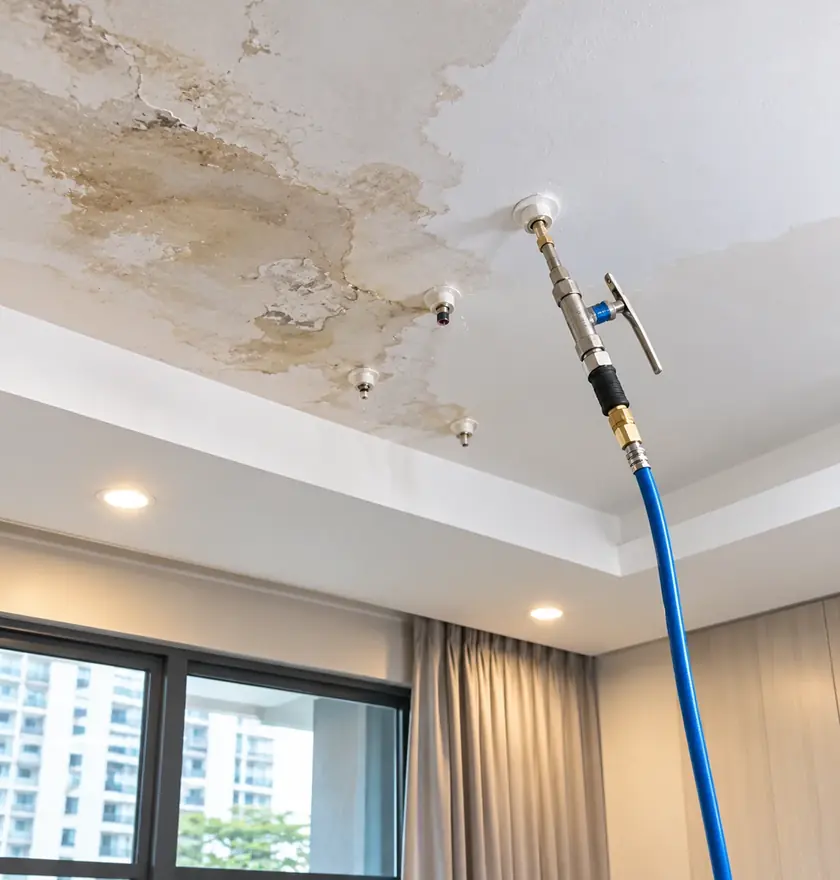
Allseal Waterproofing Pte. Ltd. provides ceiling leakage repair across Singapore. We trace where the water is actually coming from, then recommend a suitable fix, including PU injection where the slab allows. Free site inspections are usually available the same day.
Free site inspection,usually available the same day.
What to Look For
Common Signs of Ceiling Leakage
Each sign tells you that moisture is present. None of them tells you, on its own, where the water starts.
Water Stains on the Ceiling
Yellow, brown, or dark rings form as water carries minerals through the plaster and leaves them behind when it dries. A stain with a hard, settled edge may be old, while one that keeps spreading points to water that is still arriving.
Water Dripping from the Ceiling
Active dripping means water has saturated the layers above and found a low point to fall from. When it drips is a useful clue: during rain, after someone upstairs showers, or constantly, regardless of either.
Peeling or Bubbling Paint
Moisture trapped behind the paint pushes it away from the surface, leaving blisters, flakes, or a chalky finish.
Damp or Soft Ceiling Surfaces
Plaster that feels cold and damp or crumbles at a touch, or false-ceiling boards that sag, show that moisture has been present for some time. Keep clear of sagging boards, as they can give way.
Cracks and Water Seepage
Water often follows cracks in the slab or plaster, leaving damp lines or white mineral deposits along them. Not every crack is leaking, though. Many are shrinkage cracks that stay dry.
Mould Growth and Musty Smells
Persistent moisture lets mould grow on ceiling paint and in corners, often with a musty smell, especially in rooms with little ventilation.
These signs confirm moisture, not its origin. Finding the origin takes investigation.
Possible Sources
What Causes Ceiling Leakage in Singapore?
A ceiling can get wet from several directions. These are the main sources we check.
Bathroom Leakage from the Upper Floor
Water from an upstairs bathroom can pass through damaged waterproofing, failed joints, or a faulty floor trap and appear on the ceiling below. It is a common cause in multi-storey homes, but it is far from the only one. Where the bathroom itself needs repair, our page on bathroom leakage repair explains the options on that side.
Leaking Water Supply or Drainage Pipes
Pipes concealed in the slab or above a false ceiling can leak at joints or through damaged sections. A leaking pressurised supply pipe may continue to leak even when water is not being used. A drainage pipe leak is more likely to become noticeable when wastewater flows through the affected section, such as when a basin drains or a toilet is flushed.
Roof Leakage
On the top floor of a building, rain entering through a damaged roof can travel through the structure and show up on the ceiling. Leaks that appear or worsen during rain point in this direction, and our page on roof leakage repair in Singapore covers them in detail.
Air-Conditioning Drainage Problems
Air-conditioning units produce condensate water that drains away through small pipes. A blocked, cracked, or poorly connected drain line can release that water around ceiling-mounted or concealed units, sometimes in rooms nowhere near a bathroom.
Cracks in the Concrete Slab and Construction Joints
Concrete slabs develop cracks over time, and construction joints are natural lines of weakness. When water reaches the top of the slab from any source, these paths can carry it through to the ceiling below.
Failed Waterproofing Systems
Waterproofing on floors, balconies, planters, and roof slabs ages, and some is installed poorly in the first place. Once it fails, the slab beneath is exposed to water it was never meant to carry.
A ceiling leak does not always come from the bathroom above. The source has to be established on site.
Leak Detection
How Do We Trace the Source of a Ceiling Leak?
Repainting a stained ceiling without finding the source only hides the problem until the next leak.
Water can travel through slabs, along beams, and inside joints before it appears, so the stain on your ceiling may not sit directly below the source. Our investigation usually covers:
The stains and damp areas, including how they change over time.
The timing: whether the leak follows rain, use of the bathroom upstairs, air-conditioner use, or none of these.
Bathrooms, plumbing points, and drainage above the affected area, where access is available.
Roof-related entry points for top-floor units and landed homes.
Cracks, joints, and other weak points in the slab.
Earlier repair work, if the leak has come back.
Water testing or other investigation, where suitable.
Visual checks alone cannot reveal every hidden leak. Where the evidence is unclear, we explain what further testing may be needed before recommending a repair.
Repair Options
Ceiling Leakage Repair Methods
The repair follows the diagnosis. These are the main approaches, and many jobs combine more than one.
PU Injection Waterproofing
PU injection seals water paths inside the concrete slab, often from the ceiling side, so the unit above may not need to be disturbed. It suits certain active leaks through cracks and joints. However, this approach is not suitable for every leak. If the source is a defective pipe or a widely deteriorated waterproofing system, work at the source may still be necessary. The next section explains how it works and where it falls short.
Crack Injection and Sealing
Cracks that are not suited to PU injection may be treated with other compatible injection or sealing materials. The choice depends on the crack’s width, its movement, and whether water is still flowing through it.
Waterproofing Treatment at the Source
Some leaks can only be stopped where the water enters, such as a bathroom floor upstairs, a roof slab, or a balcony. Treating the ceiling from below may slow these leaks, but the lasting fix is at the source above.
Plumbing Repair
If a leaking supply or drainage pipe is confirmed, the pipe or joint needs to be repaired. Certain water service and sanitary plumbing works in Singapore must be carried out by a PUB Licensed Plumber, so we advise you on the right next step whenever plumbing is involved.
Ceiling Surface Restoration
Once the source is fixed and the area has dried out, damaged plaster, paint, or ceiling boards can be repaired. This is a separate step. Restoring the surface makes the ceiling look right again, but it does not stop water on its own.
These are general approaches. The right one depends on the source, the building’s structure, and the condition of the affected area.
PU Injection
PU Injection Waterproofing for Ceiling Leaks
PU injection is one of the most useful methods for ceiling leaks, provided it is used where it suits.
What Is PU Injection Waterproofing?
PU injection waterproofing is a repair method in which polyurethane resin is injected under pressure into cracks or water paths in concrete. Its purpose is to block the route that water takes through the structure.
How Does PU Injection Work?
The exact procedure varies with the product and the site, but a typical PU injection repair generally follows these steps:
1 The leak path is located, usually a crack or joint that shows damp or active seepage. 2 Small holes are drilled along or across the crack, and injection packers are fitted. 3 The resin is pumped in under pressure until it fills the path. 4 Depending on the product formulation, the resin reacts with moisture and expands or cures, forming a water-resistant seal. 5 The packers are removed and the holes are sealed.
Choosing the right injection points matters as much as the material. Resin injected in the wrong place can leave the real water path open.
When Is PU Injection Suitable?
It tends to work best where water is coming through defined cracks or joints in a concrete slab, where the leak is active or recurring, and where hacking the floor above would be impractical or highly disruptive.
What Are the Limitations of PU Injection?
Not every crack is suitable for injection. It will not fix a leak caused by a defective pipe, which still needs plumbing repair. Where the waterproofing above has deteriorated widely, a broader repair at the source may be needed. The right material and method depend on site conditions, so results vary from case to case.
We recommend PU injection only when the inspection shows that it fits the problem.
Surface vs Source
Repairing the Ceiling vs Fixing the Source of the Leak
Both may be needed, but they solve different problems, and the order matters.
Aspect
Ceiling surface repair
Leak source repair
What it addresses
Stains, peeling paint, and damaged plaster or boards
The point where water enters
Result
Restores the appearance of the ceiling
Aims to stop water from reaching the ceiling
When it is done
After the leak has stopped and the area is dry
First, before any final finishing
Limitation
Does not prevent further leakage
Depends on a correct diagnosis and a suitable method
Patching or repainting a ceiling before the source is fixed usually means the stain returns, and you pay for the finish twice.
Property Types
Ceiling Leaks Across Different Property Types
Where the water comes from often decides who is responsible and who needs to be involved.
HDB Flats
In HDB flats, a ceiling leak may come from the flat above, from the roof for top-floor units, or from common property. HDB’s guidance states that flat owners are responsible for the upkeep and maintenance of their respective flats, including the floor and ceiling slabs. Where a leak is traced to renovation works in the upper flat, the upper-floor owner is generally responsible for the repair. Leaks into top-floor flats from the roof come under the town council, as the roof is common property. Responsibility depends on the source and circumstances, so refer to HDB’s guidance on ceiling leaks or contact your town council where common property may be involved. Tracing the source often needs access to the flat above, so it helps to speak to your neighbour early.
Condominiums and Apartments
Condo ceiling leaks can come from an upstairs bathroom, concealed plumbing, the roof, or common property. Access to the unit above, and approval for work on common areas, may require coordination with the neighbour, the MCST, or the managing agent.
Landed Properties
In landed homes, the leak usually starts within your own property, from the roof, an upstairs bathroom, concealed plumbing, or exposed areas such as balconies and car porches. Access is simpler, but the source can still be some distance from the stain.
Commercial Properties
In offices, shops, and other premises, a ceiling leak can damage fittings, stock, and equipment, and disrupt day-to-day business. Investigation and repair need to be planned around operating hours where possible.
Our Process
Our Ceiling Leakage Inspection and Repair Process
Clear steps, with the price agreed before anything is done.
01
Initial enquiry. Call or WhatsApp +65 8360 1752. Photos of the ceiling and a note on when the leak appears help us prepare.
02
Site inspection. A supervisor examines the ceiling and checks likely sources where access is available. The visit is free and usually available on the same day, subject to availability.
03
Leak assessment. We review the findings to identify the likely source and the repair options that suit it.
04
Written report and quotation. You receive our findings, the recommended method, the scope, and the price in writing.
05
Repair work. Our in-house team carries out the agreed work. Payment is 50% before work starts and 50% on completion.
06
Surface restoration. Where it is part of the agreed scope, we restore the ceiling finish once the source is fixed and the area has dried.
07
Handover. We explain the completed work and the applicable warranty, as set out in our warranty terms.
What are the common causes of ceiling leakage in Singapore?
The most common causes are leaks from an upstairs bathroom, leaking supply or drainage pipes, roof leaks in top-floor units, blocked air-conditioning drain lines, and water passing through cracks or failed waterproofing in the slab above. More than one cause can be involved, which is why the source has to be confirmed on site.
Why is water dripping from my ceiling?
Dripping means enough water has collected above the ceiling to fall through. The timing is the best early clue. Dripping during rain suggests the roof or exterior, dripping after the upstairs bathroom is used suggests a bathroom or drain leak, and constant dripping often points to a pressurised supply pipe. An inspection confirms which applies.
Can ceiling leakage come from the bathroom above?
Yes, it is a common source in multi-storey homes. Water can pass through worn waterproofing, a faulty floor trap, or failed joints in the bathroom upstairs and appear on your ceiling. It is not the only possibility, though, so pipes, the roof, and air-conditioning drains should also be checked.
How can I identify the source of a ceiling leak?
Start by noting when it happens: during rain, after the upstairs bathroom is used, when the air-conditioner runs, or all the time. Photos taken over a few days also help. A professional inspection then checks the likely sources above, along with cracks and joints, and may include water testing where suitable.
What is PU injection waterproofing?
It is a repair method in which polyurethane resin is injected under pressure into cracks or water paths in a concrete slab. Depending on the product, the resin reacts with moisture and expands or cures to seal the path. For ceiling leaks, it can often be carried out from below, without disturbing the unit above.
Can PU injection stop ceiling leakage permanently?
PU injection can stop water passing through a suitable crack or joint, but no method can promise permanent results in every case. How long the repair lasts depends on the condition of the slab, building movement, and whether the original source above has deteriorated. If the waterproofing above is failing widely, repair at the source may also be needed.
Can a ceiling leak be fixed without hacking the floor above?
Often, yes. Where water is coming through defined cracks or joints, PU injection or other injection methods from the ceiling side may stop the leak without hacking the floor upstairs. Where the waterproofing above has failed across a large area, or a pipe is leaking, work at the source is usually needed.
My HDB ceiling is leaking. Who should I contact first?
If you live on the top floor and the leak comes from the roof, contact your town council, as the roof is common property. If the leak appears to come from the flat above, speak to your neighbour, since HDB expects flat owners to maintain the floor and ceiling slabs of their flats, and the cause of the leak affects who is responsible. HDB’s ceiling leak guide explains the next steps.
How long does ceiling leakage repair take?
It depends on the source and the method. A targeted injection repair is generally quicker than work involving the bathroom or roof above, and ceiling restoration can only start once the area has dried. We include an expected timeline with the written quotation.
How much does ceiling leakage repair cost in Singapore?
The cost depends on where the water is coming from, how much of the ceiling is affected, access to the source, the method needed, and whether the finish must be restored. An injection repair from below is priced very differently from work on the bathroom above. We quote in writing after a free site inspection.
Water Stain on Your Ceiling? Let’s Find the Source
Contact Allseal to arrange a free inspection and discuss a suitable repair. Call or WhatsApp +65 8360 1752, or email allsealwaterproofingsg@gmail.com, and our team will get back to you quickly.