
Key Takeaways
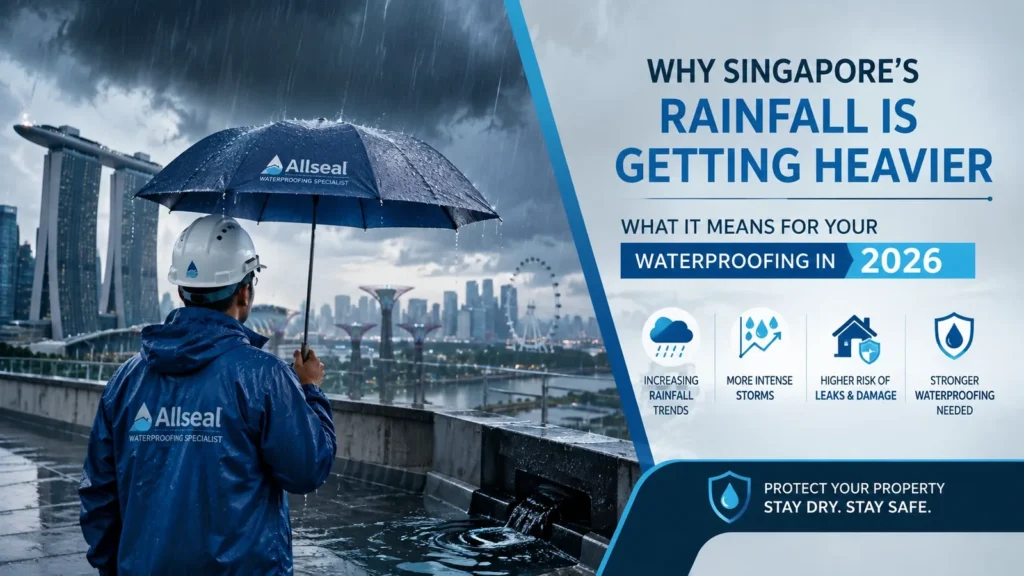
- Singapore’s annual rainfall has been rising by roughly 83mm per decade since 1980, according to Singapore’s National Climate Change Secretariat (NCCS).
- 2024’s total rainfall was 8.1% above the long-term average; 2025 came in 18% above average, based on NEA’s annual climate assessment.
- Singapore’s Third National Climate Change Study (V3) projects extreme daily rainfall increasing by 6% to 92% during the inter-monsoon months, with sharper contrasts between wet and dry periods.
- Heavier, more frequent downpours put more pressure on waterproofing systems — meaning membranes are reaching the end of their working life faster than the “5–10 years” estimates most homeowners plan around.
It’s Not Your Imagination — Singapore Really Is Getting Wetter
If it feels like heavy downpours are becoming more frequent and more intense, the data agrees with you. This matters for waterproofing specifically, because every roof membrane, balcony coating, and bathroom seal is essentially engineered against an assumed level of water exposure. When that exposure increases faster than expected, ageing waterproofing systems fail sooner than their rated lifespan suggests — which is exactly the pattern we’ve been seeing more of in recent inspections across HDB, condo, and commercial properties in Singapore.
The Data: How Much Has Singapore’s Rainfall Actually Increased?
According to Singapore’s National Climate Change Secretariat, the country’s annual rainfall total has been increasing at a rate of about 83mm per decade between 1980 and 2022. That trend has continued in recent years:
- 2024: total rainfall came in 8.1% above the long-term average.
- 2025: total rainfall reached 2,984.9mm — 18% above the long-term average, according to NEA’s annual climate assessment. January 2025 was the 6th wettest January since 1980, and March 2025 was the wettest March since 1980.
- La Niña conditions — associated with wetter weather over this part of the Pacific — were present for most of 2025, and have recurred in multiple recent years, contributing to these anomalies.
These aren’t small statistical blips. A near-fifth above the long-term average, in a single year, is a meaningful shift for anything designed to shed water — roofs, balconies, external walls, and below-grade waterproofing all included.
What the Third National Climate Change Study (V3) Projects Going Forward
In January 2024, the Centre for Climate Research Singapore (CCRS) released Singapore’s Third National Climate Change Study (V3) — the most detailed climate projection Singapore has produced to date. Some of the key findings directly relevant to property owners:
- Extreme daily rainfall is projected to increase across all seasons, with the inter-monsoon months of April and May seeing increases of 6% to 92%, depending on the emissions scenario.
- The contrast between wet months (November to January) and dry months (February, and June to September) is expected to become more pronounced — meaning Singapore isn’t just getting more rain overall, it’s getting more concentrated, higher-intensity rain events, interspersed with longer dry spells.
- Flash flood events linked to heavy rainfall have already become more common, and this trend is expected to continue as the climate warms further.
- Beyond rainfall, the study also projects rising sea levels — up to 1.15 metres by 2100, with transient surges of 4–5 metres possible during a confluence of extreme high tides and storm surges — which matters for basement and below-grade waterproofing in low-lying areas.
Why More Rain Doesn’t Just Mean “More Water” — It Means More Pressure on Weak Points
It’s tempting to think of increased rainfall as simply “more of the same, but more often.” In practice, it changes the physics of how water interacts with a building in three important ways:
- Higher-intensity downpours overwhelm drainage faster. A roof or balcony drainage system designed decades ago for a certain rainfall intensity may now regularly exceed that design threshold, leading to pooling and prolonged water contact with vulnerable joints and edges.
- Wetter periods mean less time for materials to dry out between rain events. Waterproofing membranes and sealants that rely on drying cycles to maintain their integrity are under near-constant moisture load during extended wet spells.
- Sharper wet-dry contrasts stress materials through expansion and contraction. Concrete and sealant joints that swell during heavy, prolonged rain and then shrink during longer dry spells experience more cyclical stress — which accelerates the formation of hairline cracks that let water in.
Which Parts of a Singapore Property Are Most Vulnerable Right Now
Not every part of a building is affected equally. Based on the pattern of leak calls we see, these are the areas under the most pressure as rainfall intensity rises:
- RC (reinforced concrete) roofs — the most exposed surface on any building, and the first to show pooling and membrane wear during intense rain. See our RC roof waterproofing service for how this is typically addressed.
- Metal roofs — heavier, more frequent rain accelerates corrosion at joints and fastener points where coatings have thinned. Our guide on preparing your roof for rainy season covers seasonal checks worth doing now.
- Balconies — ponding is one of the earliest visible signs of a membrane under stress; see our breakdown of balcony waterproofing costs if yours is due for renewal.
- External walls and facades — increasingly common source of seepage in older buildings as wind-driven rain during intense storms pushes water into hairline cracks.
- Basements and below-grade areas — more relevant for landed properties and larger developments, especially given the long-term sea level and groundwater implications noted in the V3 study.
How Rising Rainfall Intensity Shortens the Real Lifespan of Ageing Waterproofing
Most waterproofing materials are quoted with a lifespan range — often cited as somewhere between 5 and 10 years, depending on the material and application. That range, however, assumes a fairly stable level of rainfall exposure. If actual rainfall intensity is running well above the historical average — as 2024 and 2025 both were — a membrane installed 8 years ago under “normal” assumptions may already be operating well past its effective working life, even if it hasn’t shown visible symptoms yet.
This is why we increasingly recommend inspection based on age and rainfall exposure, not just visible symptoms. By the time a stain appears on a ceiling or wall, the underlying membrane failure has usually been progressing for months already. Our detailed explainer on how waterproofing specialists diagnose structural water damage covers how this kind of early-stage assessment works in practice.
Commercial & MCST-Managed Buildings: A Bigger Responsibility
For property managers and MCSTs, rising rainfall intensity isn’t just a maintenance inconvenience — it’s a growing liability question. Common property like roofs, external walls, and facades falls under the MCST’s maintenance responsibility, and a membrane that fails during an unusually heavy storm can trigger disputes over whether it was reasonably maintained. We’ve written specifically about why property managers should schedule regular waterproofing inspections, and this climate trend makes that case stronger, not weaker, heading into 2026.
What This Means Differently for HDB, Condo, and Landed Properties
The impact of rising rainfall intensity isn’t identical across property types, since each has different exposure points and different lines of responsibility:
- HDB flats: Owners are typically responsible for waterproofing within their own unit (bathroom, kitchen, household shelter), while common areas like the main roof fall under HDB or town council maintenance. Older HDB blocks with ageing roof membranes are worth flagging to your town council if you notice recurring ceiling seepage after heavy rain, since the underlying membrane may already be past its effective lifespan.
- Condominiums: Individual units are responsible for internal waterproofing (bathrooms, balconies within unit boundaries), while the MCST is responsible for common property — roofs, facades, and shared infrastructure. As covered in our guide on who pays for water leaks in Singapore condos, this distinction becomes more contentious as more frequent heavy rain increases the number of borderline cases.
- Landed properties: Owners carry full responsibility for the entire building envelope, including roof, external walls, and any below-grade waterproofing. This is also the property type most directly exposed to the sea-level and groundwater implications raised in the V3 study, particularly for homes in low-lying areas.
Regardless of property type, the underlying lesson from the data is the same: the assumptions your waterproofing was originally designed around are shifting, and maintenance schedules that made sense a decade ago may now need to be reviewed more frequently.
A Practical Checklist Before the Next Rainy Season
Given what the data shows, here’s a realistic set of priorities for property owners and managers heading into another wetter-than-average year:
- Reassess waterproofing age against actual rainfall exposure, not just the original warranty period.
- Inspect roof and balcony drainage outlets for blockages before the next heavy rain period — reduced drainage capacity is one of the fastest ways a downpour turns into ponding damage.
- Check external wall joints and sealant lines, especially on facades facing prevailing wind-driven rain.
- Prioritise areas with a documented history of past seepage — once a membrane has failed and been patched, it’s statistically more likely to need attention again sooner, especially under heavier rainfall conditions.
- Consider proactive renewal over reactive repair for any waterproofing system approaching, or past, the middle of its expected lifespan.
Frequently Asked Questions
Is Singapore’s rainfall actually increasing, or does it just feel that way? It’s a measurable trend. Singapore’s National Climate Change Secretariat reports annual rainfall rising by roughly 83mm per decade since 1980, with 2024 and 2025 both coming in well above the long-term average (8.1% and 18% respectively, according to NEA).
What does the Third National Climate Change Study (V3) say about future rainfall in Singapore? Released by CCRS in January 2024, V3 projects extreme daily rainfall increasing across all seasons, with the sharpest rises — 6% to 92% — expected during the April–May inter-monsoon period, alongside more pronounced wet-dry contrasts and more frequent flash flooding.
Does heavier rainfall mean my waterproofing will fail sooner than expected? Potentially, yes. Waterproofing lifespan estimates assume a fairly stable level of rainfall exposure. If actual rainfall intensity is well above historical norms, as recent years have been, membranes can reach effective failure earlier than their quoted lifespan suggests, even before visible symptoms appear.
Which parts of a property are most at risk as rainfall intensifies? RC and metal roofs, balconies, and external wall facades tend to show stress first, since they’re the most directly exposed to wind-driven and pooling rainwater. Basements and below-grade areas are also a growing concern given long-term sea level projections.
How often should I get my property’s waterproofing inspected given these trends? As a general guide, bathrooms, balconies, and roofs older than 8–10 years should be inspected more proactively rather than waiting for visible signs of damage — especially given that recent years have seen rainfall well above long-term historical averages.
Not sure how much life is left in your roof, balcony, or bathroom waterproofing? Contact Allseal Waterproofing for a free on-site inspection, or call +65 8360 1752.