
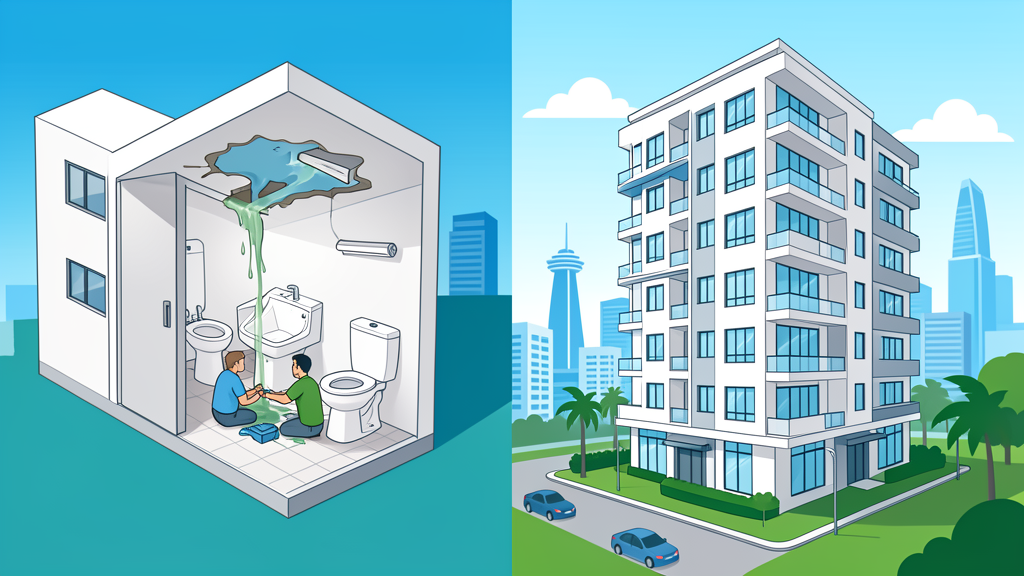
If you live in Singapore, your home is likely one of two types: an HDB flat or a private condominium. Both need waterproofing. Both can leak. But the rules, responsibilities, and repair processes are completely different.
Understanding the difference between HDB and condo waterproofing can save you thousands of dollars, months of disputes, and a lot of frustration. I am Tareq Aziz from Allseal Waterproofing. Over the past 15+ years, we have handled hundreds of waterproofing cases across both HDB flats and private condos in Singapore. The mistakes homeowners make are surprisingly consistent — and they almost always stem from not understanding who is responsible for what.
This guide explains the key differences between HDB and condo waterproofing in Singapore: the rules you must follow, who pays for what, and exactly what to do when a leak appears.
HDB Waterproofing: Rules and Responsibilities
HDB flats are public housing governed by the Housing & Development Board. Waterproofing in HDB flats is heavily regulated because of the stacked nature of the buildings — one unit’s bathroom leak can become the neighbour’s ceiling problem.
The 3-Year Lock-In Rule
For new BTO flats, HDB enforces a strict rule: you cannot hack or replace floor and wall tiles in wet areas for the first 3 years. This allows the building structure to settle and protects the original waterproofing membrane warranty. Breaking this rule voids your HDB bathroom waterproofing warranty entirely.
Mandatory 24-Hour Water Ponding Test
Any renovation involving wet areas in an HDB flat requires a mandatory 24-hour water ponding test. The process is simple but critical: the contractor seals all floor traps, floods the floor with approximately 25mm of water, waits 24 hours, and then a HDB-approved inspector checks the unit below for any signs of leakage. If the test fails, the contractor must strip the membrane and redo the entire waterproofing layer.
Approved Contractors
HDB requires all renovation contractors to be registered in the Directory of Renovation Contractors (DRC). Only DRC-listed contractors are allowed to perform renovation work in HDB flats, including waterproofing. Always verify your contractor’s DRC status before signing any contract. At Allseal, we are fully DRC-registered and specialize in no-hacking waterproofing solutions for HDB flats.
Warranty Period
New BTO flats come with a 5-year warranty for ceiling leaks and external wall seepage. For resale flats or renovated units, the warranty depends on your contractor — typically 1 to 5 years.
Condo Waterproofing: Rules and Responsibilities
Private condominiums operate under a completely different legal framework. They are governed by the Building Maintenance and Strata Management Act (BMSMA) and managed by a Management Corporation Strata Title (MCST).
Common Property vs Private Property
This is the most important distinction. Common property (external walls, roof, corridors, basement) is maintained and insured by the MCST. Private property (interior of your unit, internal walls, bathroom floors) is your responsibility. Determining liability requires professional leak detection by a qualified waterproofing specialist.
MCST Approval for Waterproofing Work
Condos require MCST approval for renovations. This typically involves submission of renovation plans, payment of a renovation deposit ($1,000-$5,000), use of MCST-approved contractors, and compliance with the condo’s quiet hours. Mandatory waterproofing is required for any wet area renovation.
Inter-Floor Leakage in Condos
When a leak occurs between condo units, the MCST mediates. If the leak originates from the upper unit’s private area, the upper unit owner is liable. If it originates from common property, the MCST is liable. If the source cannot be clearly identified, costs may be shared. This is why professional leak diagnosis is critical before any repair work begins.
HDB vs Condo Waterproofing: Key Differences
- Governing body: HDB vs MCST
- Legal framework: HDB policies vs BMSMA + condo by-laws
- Renovation approval: HDB permit required vs MCST approval + renovation deposit
- Contractor requirement: Must be HDB DRC-registered vs varies by condo
- Water test: Mandatory 24-hour ponding test vs MCST-dependent
- 3-year lock-in: Yes for BTO vs No for condo
- Common area leaks: HDB manages vs MCST manages common property
A. Cost Comparison: HDB vs Condo Waterproofing in Singapore
Waterproofing costs in Singapore vary significantly between HDB flats and private condominiums, depending on the scope of work, the size of the affected area, and the type of repair method required. For HDB flats, a standard bathroom waterproofing job — including membrane application, tile grouting, and the mandatory 24-hour ponding test — typically ranges from $800 to $2,500 per bathroom. Smaller common toilets can cost between $500 and $1,000, while master bathrooms with larger floor areas may go up to $2,500 or more. Ceiling leak repairs in HDB flats, often caused by a neighbour’s failed waterproofing, are more affordable at $300 to $800 depending on the extent of water damage and the repair method used (PU injection vs. membrane patch).
For condominiums, the cost structure is similar but often higher due to additional MCST compliance requirements, higher material specifications, and restricted working hours. Condo bathroom waterproofing ranges from $800 to $1,500 for a common bathroom and $1,500 to $3,000+ for a master bathroom. Balcony waterproofing in condos, a common issue in Singapore’s high-rise living environment, typically costs $2,000 to $5,000. On top of contractor fees, condo owners must factor in the MCST renovation deposit ($1,000 to $5,000), which is refundable upon successful completion and inspection. Always request a free on-site assessment from a qualified specialist — most reputable contractors, including Allseal Waterproofing, provide this at no charge before issuing a detailed quotation.
B. Real Case Study: A Common HDB Ceiling Leak Scenario
The Problem
A family living in a 20-year-old HDB resale flat in Ang Mo Kio began noticing brownish water stains spreading across their master bedroom ceiling. Over the next two weeks, the stains grew larger, paint started peeling, and a persistent musty odour developed. The leak was coming from the bathroom directly above — the upstairs neighbour’s unit.
The Investigation
Allseal Waterproofing was called in to assist. Our technician conducted a thorough inspection using moisture detection tools and a pressure test of the upstairs bathroom’s waterproofing membrane. The diagnosis revealed that the original waterproofing membrane — installed over 15 years ago during the last renovation — had deteriorated at the floor trap and corner joints, allowing water to seep through the concrete slab.
The Solution
Since the leak was active but the damage was localised, we recommended a minimally invasive approach. A polyurethane (PU) injection grouting was performed at the identified entry points, which expanded to seal the cracks from within the concrete. This was followed by a targeted reapplication of liquid waterproofing membrane over the affected area in the upstairs bathroom. The entire repair took two days, with no hacking or tile removal required. The ceiling was then restored with a fresh coat of anti-mould paint. Cost to the upstairs owner: $1,200. The 24-hour ponding test passed on the first attempt, and there have been no further leaks in over 18 months of follow-up.
C. Step-by-Step: What to Do When You Discover a Leak
Discovering a water stain or drip in your HDB flat or condo can be stressful, but following the right steps will save you time, money, and neighbourly friction. Here is a clear, actionable checklist:
- Document everything immediately. Take clear photos and videos of the leak, water stains, peeling paint, and any pooling water. Note the date and time. This evidence is crucial for insurance claims and dispute resolution. For the payment question in full detail, see who pays for water leaks in a Singapore condo. Our guide to home insurance and water leaks in Singapore explains what policies usually cover before you file.
- Notify your neighbour (HDB) or MCST (condo) in writing. For HDB flats, inform your upstairs neighbour politely — most leaks originate from the unit above. For condos, inform the MCST management office via email so there is a written record. Avoid confrontations; leaks are rarely intentional.
- Engage a professional leak detection specialist. Do not attempt DIY repairs or patch jobs. A qualified specialist uses moisture meters, thermal imaging, and pressure testing to pinpoint the exact source before any work begins.
- Determine liability and approval requirements. For HDB flats, confirm whether the work requires a renovation permit and a mandatory 24-hour ponding test. For condos, check your MCST by-laws and submit renovation plans for approval before work starts.
- Choose a qualified contractor and get a written quotation. Ensure they are HDB DRC-registered (for HDB work) or MCST-approved (for condos). Compare at least two quotations and verify the warranty period.
- Schedule the repair and arrange access. Coordinate access with your neighbour or MCST. After completion, request a final inspection report and warranty certificate.
D. Why Professional Waterproofing Matters in Singapore
Singapore’s tropical climate — with an average annual rainfall of over 2,300 mm, humidity levels consistently above 80%, and intense UV exposure — places extreme stress on building waterproofing systems. While DIY quick fixes and unqualified handymen may seem like a cheaper option upfront, they almost always lead to recurring problems and higher costs down the road. Professional-grade liquid membranes, PU injection grouting, and cementitious coatings are designed to last 5 to 10 years when properly applied. DIY patch jobs from hardware stores often fail within months under Singapore’s heavy rain and humidity.
Reputable waterproofing contractors in Singapore provide a formal warranty certificate (typically 1 to 5 years). If a leak recurs within the warranty period, the contractor returns to fix it at no additional cost — giving you genuine peace of mind. Modern no-hacking waterproofing methods from specialists like Allseal can stop leaks without tearing out tiles or disrupting your home, saving you thousands in restoration costs.
E. When to Call Allseal Waterproofing for Your HDB or Condo
Many homeowners wait until a small stain becomes a dripping emergency before calling a specialist. At Allseal Waterproofing, we recommend reaching out at the earliest sign of trouble — or better yet, before a leak develops. Call us at +65 8360 1752 for a free on-site inspection today, or request one online — our waterproofing specialists in Singapore cover HDB flats, condos and landed homes island-wide, from RC roof waterproofing to bathroom and balcony leak repair.
Allseal Waterproofing PTE Ltd
215 Ang Mo Kio Ave 1, #01-893, Singapore 560215
Phone: +65 8360 1752
Frequently Asked Questions
Q: Do I need HDB approval to waterproof my bathroom?
A: Yes. You must engage a DRC-registered contractor who will apply for the necessary HDB renovation permit and arrange the mandatory 24-hour ponding test.
Q: Can I waterproof my condo bathroom without MCST approval?
A: No. Check your MCST by-laws. Most condos require renovation plan submission before any work begins.
Q: Who pays if a leak from upstairs damages my ceiling?
A: In both HDB and condo, the upstairs unit owner is liable. In HDB, HDB mediates. In condo, the MCST mediates.
Q: How long does bathroom waterproofing take in Singapore?
A: Typically 1 to 3 days for the waterproofing application. For a full bathroom overhaul, expect 5 to 10 days.
Q: Can Waterproofing Specialist Singapore handle both HDB and condo projects?
A: Yes. We are HDB DRC-registered and have completed hundreds of projects for both HDB and condo balcony waterproofing and other projects across Singapore. Contact us at +65 8360 1752 for a free on-site inspection.
Lorem ipsum dolor sit amet, consectetur adipiscing elit. Ut elit tellus, luctus nec ullamcorper mattis, pulvinar dapibus leo.