
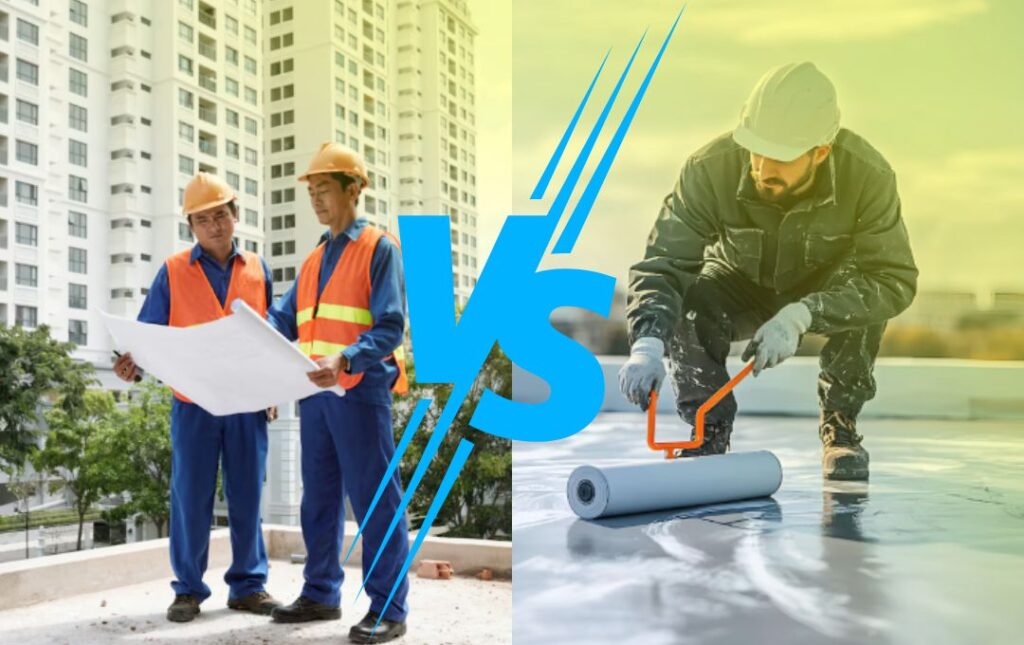
When water starts leaking from the ceiling or walls, or when they feel damp, the first question that comes to mind is simple. Who should I call between a waterproofing specialist vs general contractor? Many people feel confused here, so let’s break it down in a very simple and clear way.
Both a waterproofing specialist and a general contractor can fix problems in a building, but they do not work in the same way, and they do not focus on the same things. Understanding the difference can save you money, time, and a lot of future headaches.
Let’s walk through it step by step.
Who is a Waterproofing Specialist?
A waterproofing specialist focuses on stopping water problems and protecting buildings from moisture damage.
They deal with things like —
- roof leaks
- bathroom water leakage
- wall seepage
- balcony cracks
- ceiling stains
- basement dampness
- swimming pool leaks
Their job is not just cover the problem but to find where the water comes from and stop it at the root.
For example, if water drips from your ceiling, a waterproofing specialist will first trace the source. It could be a cracked roof slab, broken membrane, or pipe joint. They will repair the actual cause, apply proper waterproof layers, seal gaps, and test again.
Their tools, materials, and skills are made only for waterproofing work.
Who is a General Contractor?
A general contractor handles many types of building work.
They manage projects like —
- renovations
- painting
- flooring
- plumbing
- electrical work
- tiling
- carpentry
They coordinate different workers and finish the job as a whole.
If water leakage appears during a renovation, a general contractor may fix it as part of the project. They often repair by changing tiles, redoing plaster, or repainting the area. But their main role is not to deeply solve waterproofing problems.
They are good for building and remodelling. They are not trained only to stop water seepage.
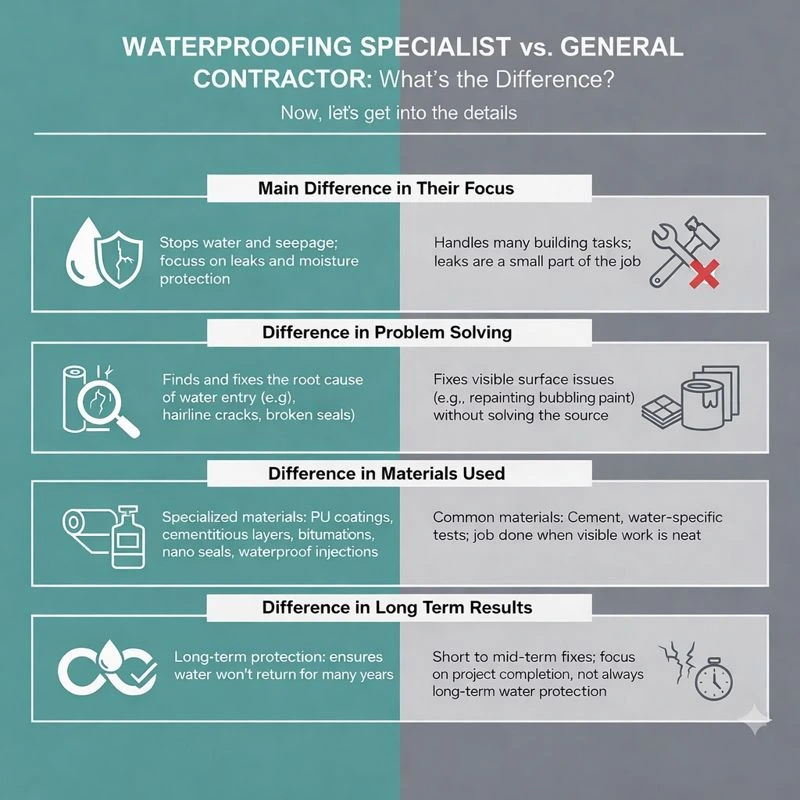
Waterproofing Specialist vs General Contractor: What’s the Difference?
Now, let’s get into the details.
Main Difference in Their Focus
A waterproofing specialist lives and breathes water problems. Their daily work revolves around finding leaks, stopping seepage, and protecting buildings from moisture. Every job they take is connected to water in some way. They study how water moves through walls, floors, and roofs. They understand how humidity, rain, and pipe leaks slowly damage a structure if not handled properly.
A general contractor, on the other hand, handles many building tasks, not just leaks. One day they may manage tiling, another day painting, then electrical or carpentry work. Water problems are just one small part of what they do, not their main focus.
So when a waterproofing specialist looks at your house, they think like a water problem solver. When a general contractor looks at your house, they think like a builder or renovator.
A waterproofing specialist usually asks questions like:
- Where is the water coming from exactly
- Why is it entering at this point
- How can I block this path permanently
- How can I protect this area from future rain and moisture
A general contractor usually asks:
- How do I fix this damaged area
- How do I make this wall or ceiling look good again
- How do I complete this repair as part of the overall project
That difference in thinking makes a big impact on the final result.
Difference in Problem Solving
Let’s take a very common real example.
Your wall paint starts bubbling and peeling.
A general contractor may scrape off the damaged paint, apply filler, smooth the surface, and repaint the wall. At first, everything looks perfect again. The wall looks clean, dry, and fresh. But after a few months, the same bubbles return. Why? Because the water is still entering the wall from somewhere inside or outside. The visible damage was fixed, but the real cause was never solved.
Now let’s see how a waterproofing specialist handles the same problem.
They will not rush to repaint. First, they inspect the outer wall, nearby windows, roof edges, joints, and cracks. They trace how water is getting inside. Maybe rainwater enters through a hairline crack. Maybe the seal around a window is broken. Maybe the wall surface absorbs water during heavy rain.
Once they find the real entry point, they seal those cracks, joints, and weak spots using proper waterproof coatings or membranes. Only after stopping the water completely do they recommend repainting. This time, the paint stays fine for years, not just months.
So one approach hides the problem. The other removes the problem.
That is a very important difference.
Difference in Materials Used
Waterproofing specialists use materials made specially to block and resist water for a long time. These materials are tested to survive under rain, heat, humidity, and constant moisture.
Some common materials they use include:
- PU coatings that form a flexible, waterproof layer on roofs and balconies
- Cementitious layers that stop water from passing through walls and bathrooms
- Bituminous membranes that protect roofs and slabs from heavy rain
- Nano seal solutions that penetrate deep into surfaces and block water from inside
- Waterproof injections that fill hidden cracks inside concrete
These materials are not just for covering surfaces. They become part of the structure and stop water movement from the inside out.
General contractors mainly use materials such as:
- Cement for building and repairs
- Tiles for flooring and walls
- Paint for finishing
- Plaster for smoothing surfaces
- Wood for fittings
- Normal sealants for gaps
These materials are excellent for building and finishing work. They make a place look nice and complete. But they are not designed to resist water pressure over a long time. Paint can peel. Cement can crack. Normal sealants can dry and shrink. Water always finds a way through them if waterproofing is not done properly.
That is why materials make such a big difference in water-related work.
Difference in Testing and Inspection
After completing waterproofing work, a waterproofing specialist does not just walk away. They test their work.
- They may do water ponding tests by keeping water on the surface for hours to see if anything leaks.
- They may use moisture meters to check hidden dampness inside walls.
- They may inspect joints and corners again to confirm everything is sealed properly.
This step gives confidence that the leak is truly fixed, not just hidden.
A general contractor usually finishes the visible work and moves to the next task. Their job is considered done once the wall looks clean or the tiles look neat. They rarely perform water-specific tests because that is not their core area.
This is one of the main reasons why waterproofing work needs specialists, like Allseal Waterproofing PTE Ltd. Water problems are not always visible, so proper testing is critical.
Difference in Long-Term Results
Waterproofing specialists aim for long-term protection. Their goal is to make sure water does not come back after the repair. Their work is meant to last many years, not just a few months.
They think about how the building will behave during heavy rain, humidity, and temperature changes. They plan their solutions so the structure stays dry in all these conditions.
General contractors aim to complete the project and make it look good. Their focus is on finishing the job properly from a construction or renovation point of view. Long-term water protection is not always their main concern.
So if you truly care about stopping leaks permanently and protecting your property value, waterproofing specialists are the safer and smarter choice.
Simple Comparison Table: Waterproofing Specialist vs General Contractor
| Point | Waterproofing Specialist | General Contractor |
| Main Focus | Stops water and seepage | Handles overall building work |
| Skills | Only waterproofing | Many construction tasks |
| Materials | Waterproof membranes and coatings | Cement, paint, tiles |
| Problem Solving | Fixes the root cause | Fixes surface issues |
| Testing | Water and moisture tests | Usually no water testing |
| Result | Long-term leak protection | Short to mid-term fixes |
When Should You Choose a Waterproofing Specialist?
Call a waterproofing specialist when
- You see water stains
- Paint peels repeatedly
- Walls feel damp
- Roof leaks during rain
- Bathroom water spreads to other rooms
- Balcony floor holds water
- Mould keeps coming back
These signs clearly point to water problems, not normal construction issues.
Here’s how to choose the right waterproofing contractor in Singapore.
When a General Contractor Makes Sense
A general contractor is useful when
- You renovate your whole house
- You change the flooring and walls
- You rebuild a room
- You do painting and tiling together
They are perfect for full renovation and building jobs.
But for water issues alone, they are not the best choice.
Why Using the Right Expert Matters
Using the wrong service for water problems often leads to —
- Repeated repairs
- Wasted money
- More damage later
- Health issues from mold
- Weakened building structure
Fixing water problems once, properly, is always cheaper than fixing them again and again.
Why Allseal Waterproofing is the Right Choice
At Allseal Waterproofing PTE Ltd, we focus only on waterproofing and leak protection across Singapore. We do not just cover leaks; we stop them from the source using advanced no-hacking methods, long-lasting materials, and clear inspection steps.
From roofs and bathrooms to balconies and walls, our team delivers clean, fast, and durable solutions so your home or building stays dry and strong for years.
If water worries you, Allseal stands ready to protect your property the right way.
| Get a free quote today and protect your property from water damage. Just call Allseal Waterproofing at +65 8360 1752 for fast and professional service. |