
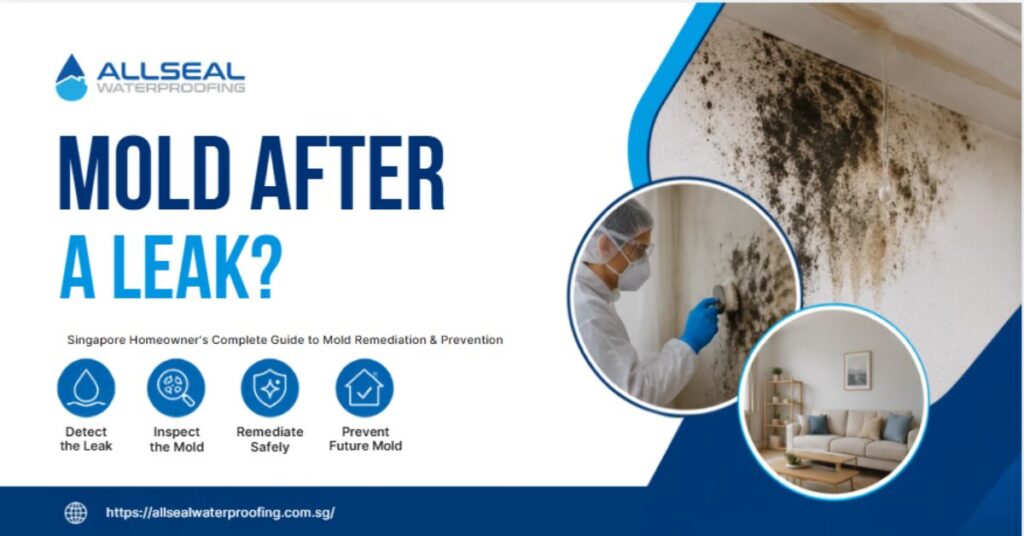
You spot it a few days after the rain finally clears — a faint grey-green fuzz creeping across a ceiling corner, right where a water stain has been slowly drying. Or maybe it’s just a musty smell in the bedroom that wasn’t there last month. In Singapore’s heat and humidity, mold after a leak isn’t a “maybe.” It’s close to guaranteed if the moisture isn’t dealt with fast.
Here’s the part most homeowners get wrong: they scrub the mold off, repaint over the stain, and move on — only to watch it creep back three or four months later, often worse than before. That’s because wiping away mold treats the symptom, not the cause. The water is still getting in somewhere.
This guide covers everything a Singapore homeowner needs after finding mold following a leak — how to tell if it’s actually mold, the health risks worth taking seriously, what you can safely clean yourself versus when to call a professional, what remediation typically costs here, and, most importantly, how to stop it from ever coming back. Let’s get into it.
Why Mold Grows So Fast After a Leak in Singapore
Singapore’s average relative humidity sits well above 70%, often climbing past 80% during the wetter months between November and January. That’s already close to the level mold needs to thrive, so when a leak adds extra moisture on top of it, conditions become close to ideal almost overnight.
In practice, mold spores that are already floating in the air can begin colonising a damp surface within a day or two of sustained wetness, and a visible patch can appear within one to two weeks if the area stays humid. This is why a “small” ceiling leak that gets ignored for a few weeks so often turns into a mold problem, while a leak that’s dried out and repaired quickly usually doesn’t.
The other factor unique to Singapore homes is enclosed, air-conditioned living. Rooms that are shut tight for hours with the aircon running trap condensation and humidity, giving any leftover moisture from a leak nowhere to escape to. That’s a big part of why mold after a leak tends to show up in bedrooms and behind wardrobes just as often as it does in bathrooms.
Mold, Water Stain, or Efflorescence? How to Tell What You’re Looking At
Not every mark left behind by a leak is mold, and treating the wrong problem wastes time and money.
- Water stains usually look like a yellow-brown ring or patch on the ceiling or wall. They’re flat, don’t have texture, and won’t wipe away easily because the discolouration has soaked into the paint or plaster.
- Efflorescence is a white, chalky, salt-like deposit that forms when water carries dissolved minerals through concrete or brick and leaves them behind as it evaporates. It’s dry, powdery, and brushes off fairly easily — a sign of ongoing moisture movement through the structure, but not mold itself.
- Mold has texture. It’s fuzzy, slimy, or speckled, and ranges from black, dark green, and grey to pink or orange. It usually comes with a musty, earthy smell that gets stronger in humid weather, and it tends to spread outward from the original wet spot rather than staying as a single flat mark.
If you’re not sure which one you’re looking at, treat it cautiously and assume it could be mold until you’ve had a closer look — the health precautions are worth taking either way.
The Health Risks of Living With Mold After a Water Leak
Mold isn’t just unsightly. For most healthy adults, brief contact with a small patch is unlikely to cause serious harm, but ongoing exposure in an occupied home is a different story.
Common symptoms linked to indoor mold exposure include sneezing, a blocked or runny nose, itchy or watery eyes, skin irritation, and a persistent cough. People with asthma, allergies, or other respiratory conditions tend to react more strongly, and mold exposure can trigger flare-ups even from levels that wouldn’t bother someone else. Young children, older family members, and anyone with a weakened immune system are generally more vulnerable.
A musty smell without any visible mold is worth paying attention to as well. It often means mold is growing somewhere you can’t see — inside a wall cavity, under flooring, or behind a built-in wardrobe — which is exactly the kind of hidden growth that keeps causing symptoms even after you’ve cleaned every visible surface.
Where Mold Likes to Hide After a Leak (Even If You Can’t See It)
Mold doesn’t always show up where the leak started. Water travels along the path of least resistance, so the visible patch is often just the tip of the problem.
Ceilings and Roof Cavities
A stained ceiling is the most obvious sign, but the moisture behind it can sit inside the concrete slab or roof structure for weeks. If the source is a cracked roof slab or failed membrane, no amount of surface cleaning fixes it — the ceiling leakage repair has to start with locating exactly where water is entering, and for RC roofs that usually means addressing it at the source through proper RC roof waterproofing.
Bathroom Walls and Tile Grout
Bathrooms are humid by nature, so a small leak in the waterproofing membrane behind the tiles can go unnoticed for a long time, showing up only as blackened grout lines or a soft patch of wall. Because the membrane sits underneath the tiles, this almost always needs professional bathroom water leakage repair rather than a re-grout.
Behind Wardrobes and on External-Facing Walls
If your bedroom shares a wall with the outside of the building, seepage after heavy rain can soak into the wall and grow mold quietly behind furniture pushed up against it. This is a classic sign of wall seepage repair being needed, not just a fresh coat of paint.
Balconies and Ledges
Ponding water on a balcony after rain, especially near door thresholds, regularly seeps into the adjoining room and causes mold along the skirting or lower wall. Balcony waterproofing that corrects drainage falls and reseals the membrane is usually the permanent fix.
Air-Conditioning Units and Ducting
Condensation drainage that isn’t flowing properly can leave a constantly damp patch around the aircon unit or its piping, which is an easy spot to overlook during a general mold check.
DIY Mold Cleanup: What You Can Safely Handle Yourself
Not every mold spot needs a professional. If the area is small — roughly less than half a square metre — and it’s on a hard, non-porous surface like tile, glass, or sealed paintwork, you can usually handle it yourself:
- Protect yourself first. Wear gloves, a mask, and if possible, eye protection. Open windows and turn on an exhaust fan for ventilation.
- Clean with a mild detergent solution. Warm water with dish soap or a household cleaner is often enough for light surface mold. Scrub gently rather than scattering spores by scrubbing too hard.
- Dry the area completely. This step matters more than the cleaning itself — mold won’t regrow on a surface that stays dry.
- Dispose of cleaning materials properly. Bag sponges, cloths, or gloves that touched the mold rather than reusing them elsewhere in the house.
- Monitor the spot for two to three weeks. If it returns, that’s a strong sign there’s still a moisture source feeding it, and DIY cleaning alone won’t solve it.
DIY is not the right approach for mold on drywall, gypsum ceiling boards, wallpaper, or other porous materials, for areas larger than about half a square metre, for mold near electrical fittings, or for anything that keeps coming back after cleaning. Porous materials absorb mold spores below the surface, so wiping the top layer just hides the problem temporarily.
When to Call a Mold Remediation & Waterproofing Professional
Bring in a professional if any of the following apply:
- The mold has come back after you’ve already cleaned it once
- You can smell mold but can’t find where it’s growing
- The affected area is larger than roughly half a square metre
- The mold is on a porous surface like plasterboard, wood, or fabric
- Anyone in the household has developed allergy-like symptoms since the mold appeared
- You genuinely don’t know where the water is coming from
That last point matters more than people expect. A huge share of recurring mold problems come down to a leak source that was never properly identified — the visible stain was treated, but the real crack, failed joint, or seepage point was missed. Specialists who focus on identifying leak sources without guesswork use moisture meters, pressure testing, and structural crack analysis to pinpoint the exact origin before any repair work begins, which is the difference between a fix that lasts and one that doesn’t.
How Professional Mold Remediation Actually Works
A proper remediation job follows a sequence, not just a spray-and-wipe visit:
- Inspection and moisture mapping. Technicians check not just the visible mold but everywhere moisture could have travelled, often as part of a broader assessment used to diagnose structural water damage in the affected area.
- Containment. The affected zone is sealed off so mold spores don’t spread to the rest of the home during removal.
- Mold removal and treatment. Contaminated surfaces are cleaned and treated with antimicrobial solutions strong enough to kill spores, not just remove visible growth.
- Drying and dehumidification. Industrial dehumidifiers and air movers dry out the structure completely, including areas that feel dry on the surface but are still damp underneath.
- Root-cause repair. This is the step a lot of cleaning-only services skip entirely — actually sealing the leak that caused the mold in the first place.
- Final inspection and report. A thorough job ends with documentation of what was found, what was done, and what warranty applies going forward.
Why Mold Keeps Coming Back If You Only Clean It (and Never Fix the Leak)
This is the part most mold guides gloss over, and it’s the single biggest reason people end up paying for mold cleanup two or three times over.
Mold removal companies are, understandably, focused on the mold. They clean it, treat it, sometimes seal the surface — and that’s the end of their job. But if the underlying leak was never repaired, the moisture simply returns, and so does the mold, usually within a few months.
A genuine fix has two parts: removing the existing mold safely, and stopping the water that fed it. That second part is a waterproofing job, not a cleaning job. It’s why working with a specialist waterproofing company in Singapore that treats mold and the leak as one problem, rather than two separate call-outs, tends to save homeowners money in the long run — one proper repair instead of repeated cleaning bills.
What Does Mold Remediation and Leak Repair Cost in Singapore?
Pricing depends heavily on the size of the affected area, the surface involved, and whether the root leak also needs repair. As a general guide for Singapore properties:
| Service | Typical Cost Range (SGD) |
| Small DIY-level mold cleanup (materials only) | $20 – $60 |
| Professional mold cleaning, per affected room | $200 – $600 |
| Comprehensive mold remediation with moisture assessment | $500 – $1,500+ |
| Ceiling leak repair (root-cause fix) | $300 – $800 |
| Bathroom waterproofing (root-cause fix) | $800 – $2,500 |
| Roof waterproofing (root-cause fix) | $1,500 – $5,000+ |
These figures are estimates. The only way to get an accurate number is a proper on-site inspection, since hidden moisture and the extent of surface damage can’t be judged from photos alone.
HDB, Condo, and Landed Property: What’s Different About Mold Repairs
HDB Flats
Mold in an HDB flat is often traced to a leak from the unit directly above, most commonly through a failed bathroom membrane. This is such a common scenario that it’s worth understanding on its own — see this breakdown of hidden leak problems in HDB bathrooms for how these leaks typically get identified and resolved. If the leak is coming from a neighbouring unit, you’ll usually need to raise it with your Town Council or the unit owner directly, since resolving liability is a separate process from the physical repair.
Condominiums
For condo units, leaks affecting common property — the main roof, external facade, or shared structural elements — usually require MCST approval before repair work can start. Leaks inside your own unit, such as bathroom or balcony seepage, are typically your responsibility to arrange and pay for directly.
Landed Houses
Landed homeowners have full control over repair timing and contractor choice, but also carry full responsibility for the roof, external walls, and drainage. Because there’s no shared body to coordinate with, catching and fixing leaks early is entirely on the homeowner.
How to Prevent Mold From Coming Back for Good
Once the mold is cleaned and the leak is repaired, prevention comes down to a handful of consistent habits:
- Keep indoor humidity between 40% and 60% using a dehumidifier in problem-prone rooms.
- Run exhaust fans during and for at least 15 minutes after showers or cooking.
- Don’t ignore small signs. A faint stain or a slightly musty smell today is far cheaper to fix than mold that’s had months to spread — this list of common mistakes homeowners make before calling a waterproofing specialist is worth a read if you’ve been putting off an inspection.
- Choose the right waterproofing membrane for the area. Not every surface needs the same treatment — this guide to different types of waterproofing membranes explains which system suits roofs, bathrooms, and balconies.
- Consider no-hacking waterproofing for problem areas. No-hacking waterproofing applies a sealing membrane without removing existing tiles, which makes it a practical option for bathrooms and balconies that keep developing mold.
- Service your aircon regularly so condensation drains properly instead of pooling.
Repainting and Restoring Your Space After Mold Removal
Once a wall or ceiling has been properly dried and the leak fixed, repainting isn’t just cosmetic — the right paint adds a layer of protection against future moisture. Moisture-resistant and mold-inhibiting paints hold up noticeably better in humid rooms than standard interior paint, and choosing well matters enough that it’s worth comparing options before you buy. Interior-exterior painting done after a proper waterproofing repair gives the space a clean, finished look while adding an extra buffer against moisture.
Choosing the Right Mold and Waterproofing Specialist in Singapore
Because mold and leaks are really the same problem, look for a specialist that handles both diagnosis and repair rather than one that only cleans surfaces.
Allseal Waterproofing has been solving leak and moisture problems across Singapore since 2014, working on HDB flats, condominiums, landed homes, and commercial buildings including projects for organisations like the Health Promotion Board, Epson Singapore, and Crowne Plaza Changi Airport. The team’s approach starts with locating the exact source of a leak using moisture detection tools, pressure testing, and crack analysis, rather than guessing based on the visible symptom — you can read more about the company’s background on the About Us page.
Real client feedback backs this up. One homeowner described being satisfied with the work months after the repair, noting that no further leakage or mould had returned since — exactly the long-term result a proper root-cause repair is meant to deliver, rather than a temporary patch that needs redoing.
Key Takeaways
- Mold can start growing within 24–48 hours of a leak in Singapore’s humid climate, so speed matters more than perfection.
- Not every stain is mold — check for texture, colour, and smell before assuming the worst.
- Small mold patches on hard surfaces can often be cleaned safely at home; anything larger, recurring, or on porous material needs a professional.
- Cleaning mold without fixing the leak that caused it almost always leads to it coming back.
- HDB, condo, and landed properties each have different processes for approving and paying for repairs.
- Prevention comes down to humidity control, ventilation, and addressing small leaks before they become big ones.
Conclusion
Finding mold after a leak is frustrating, but it’s rarely a sign that something is fundamentally wrong with your home — it’s usually just moisture that was never fully dealt with. The homeowners who solve it for good are the ones who treat mold and the leak as one job, not two: clean it properly, find out exactly where the water is coming from, and seal it at the source. If you’re dealing with mold after a leak and want a proper inspection instead of another temporary fix, you can get a free quote and have the actual cause identified before any work begins.
Frequently Asked Questions
How do I know if it’s mold or just a water stain?
Water stains are flat, dry, and don’t have texture. Mold is fuzzy, slimy, or speckled, usually comes with a musty smell, and tends to spread outward over time rather than staying as a fixed mark.
Is mold after a leak dangerous?
It can be, particularly for anyone with asthma, allergies, or a weakened immune system. Common symptoms include sneezing, coughing, skin irritation, and worsened allergy or asthma symptoms. Large infestations or black mold should always be treated seriously.
Can I clean mold myself?
Yes, if the patch is small (under roughly half a square metre) and on a hard, non-porous surface. Wear gloves and a mask, clean with a mild detergent solution, and dry the area completely. Larger or recurring mold needs professional attention.
How long after a leak does mold start growing in Singapore?
In Singapore’s humid climate, mold can begin colonising a damp surface within 24 to 48 hours of sustained wetness, with visible growth often appearing within one to two weeks if the area stays humid.
Does bleach get rid of mold for good?
Bleach can kill surface mold on non-porous materials, but it doesn’t reach mold that has grown into porous materials like drywall or wood, and it does nothing to address the moisture source. Mold on porous surfaces usually returns after a bleach clean unless the material is treated or replaced and the leak is fixed.
How much does mold remediation cost in Singapore?
Professional mold cleaning typically starts around $200–$600 per room, while comprehensive remediation that includes moisture assessment can run $500–$1,500 or more. If a leak needs repairing too, that’s a separate cost on top, ranging from around $300 for a minor ceiling fix to $5,000+ for roof waterproofing.
Will my HDB town council fix mold caused by my upstairs neighbour’s leak?
The town council typically doesn’t handle repairs inside a private unit. If the leak originates from a neighbouring flat, you’ll generally need to raise it with the unit owner or seek mediation, while any repair work in your own flat is arranged and paid for separately.
Can painting over mold fix the problem?
No. Painting over mold without cleaning it and fixing the moisture source traps the mold underneath, where it continues to grow and can bleed through the new paint within weeks or months.
How do I know if the mold will come back?
If the underlying leak hasn’t been repaired, mold almost always returns, sometimes within a few months. Monitoring the cleaned area for two to three weeks is a reasonable way to check, but a proper moisture inspection is the only reliable way to confirm the source has actually been sealed.
What’s the difference between mold remediation and mold cleaning?
Mold cleaning typically means wiping away visible growth from a surface. Mold remediation is a more thorough process that includes identifying the moisture source, containing the affected area, treating it with antimicrobial products, drying the structure fully, and repairing the leak that caused the problem.
Is black mold more dangerous than other types?
Not all black-coloured mold is the toxic variety often referred to as “black mold,” and colour alone isn’t a reliable way to identify species. Any mold that’s black in colour, covers a large area, or keeps returning should be treated cautiously and assessed by a professional rather than identified by eye.
How long does mold remediation take?
Small remediation jobs can be completed in a day. Larger jobs that include drying out a structure and repairing the source leak, such as bathroom or roof waterproofing, typically take two to five days including drying time.
Does home insurance cover mold damage in Singapore?
Coverage varies by policy and insurer, and many standard policies exclude gradual damage like mold that developed over time from an undetected leak. It’s worth checking your specific policy wording or speaking with your insurer before assuming mold remediation costs will be covered.
What paint should I use to stop mold coming back on walls and ceilings?
Look for paint specifically labelled as moisture-resistant or mold-inhibiting, particularly for bathrooms, kitchens, and any wall that has previously had a leak. Standard interior paint doesn’t offer the same resistance and can allow mold to return more quickly in humid conditions.
How can I prevent mold from returning after waterproofing repairs?
Keep indoor humidity between 40% and 60%, run exhaust fans in bathrooms and kitchens, service your air-conditioning regularly, and schedule periodic checks of previously repaired areas, especially after heavy rain or during the wetter months between November and January.